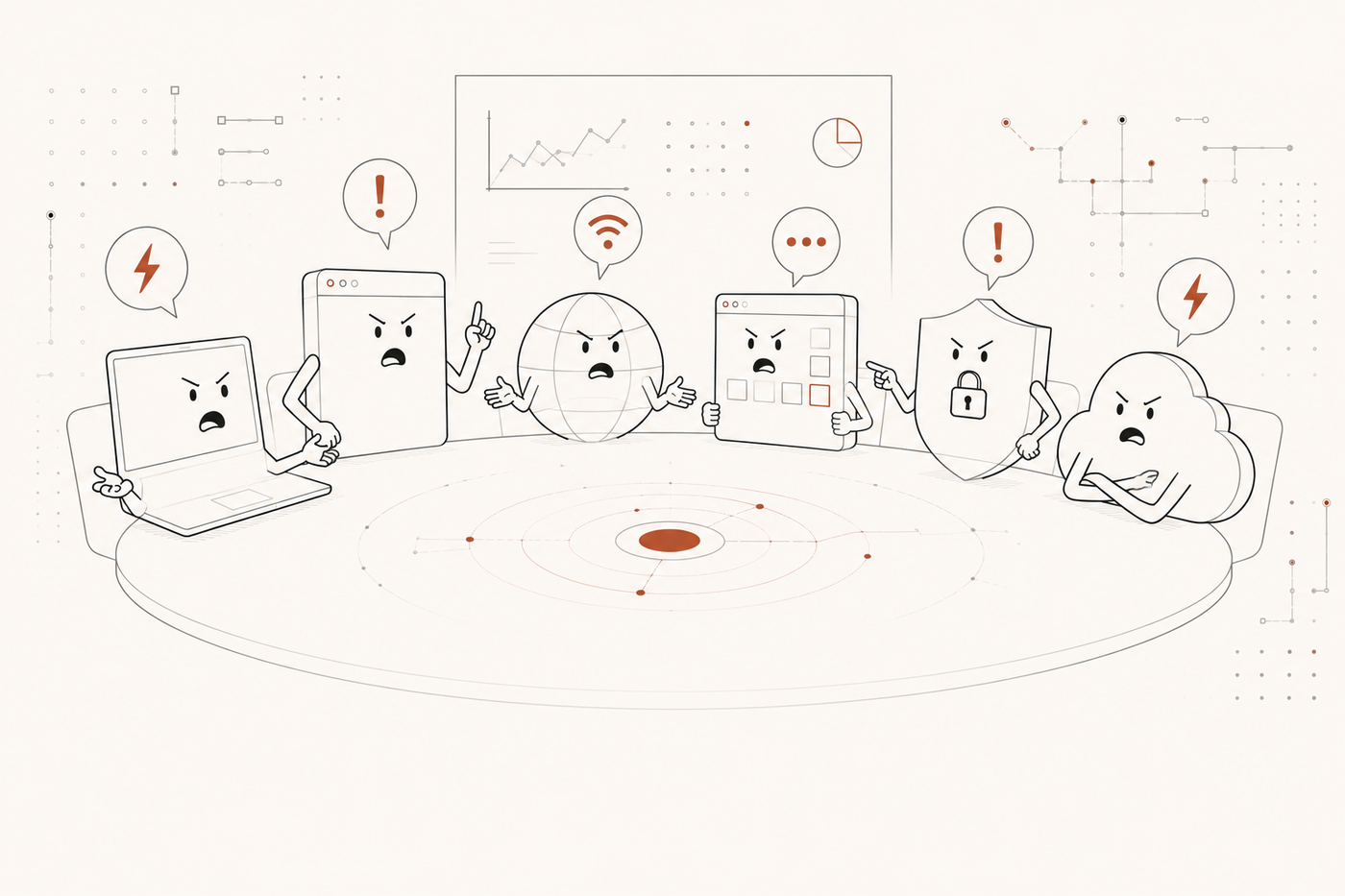
Every layer showed up to defend its worth.
It started as a routine sync. But things quickly got personal.
Device slammed the virtual table. "I'm the gateway. The employee holds me, carries me, works through me. I'm their everyday companion."
Operating System rolled its eyes. "Let's be real. Without me you're a slab. Memory, performance, security, stability — I run the show."
Network cut in, lagging slightly. "Run what you like. If I drop, everyone drops. Every action, every click passes through me. Break me and the whole experience collapses."
Cloud floated in, confident. "I've moved your apps, scaled your storage, retired your servers. You all depend on me now. Remember when I was just the weather?"
Server, old but wise, added quietly: "I've stored your histories, powered your apps, kept the lights on for years. Still here. Still vital."
Each one had a point. Each one mattered.
Then the Application spoke — calmly, but clearly.
"You're all right. You are the engine, the wiring, the structure, the sky.
But I am where it all comes together. I am the part the employee touches.
I am where the day starts — on a dashboard, a screen, a task. Where the work is done. Where decisions are made. Where frustration builds, or flow disappears.
When something lags or breaks, no one analyses the stack. They blame me, because I'm who they see.
I am the translation layer between your brilliance and their reality. The bridge between systems and souls.
I am the last mile — the final stretch where all your effort is judged in a single click, crash or delay."
The war room went quiet. Even the lag paused.
Not for long. Cloud drifted lower, cool but firm. "Nice speech. But without me your apps don't load. I scale you, update you, protect you. You ride on my back. Don't pretend you stand alone."
Application looked up, steady. "You're right. I don't stand alone. None of us do. But I stand first. And I fall first.
When I fail, nobody says 'the cloud lagged' or 'the network flickered.' They say: the app is broken.
So yes — you're the sky. But I'm the storm they feel. And that storm decides whether your brilliance reaches them, or vanishes before it ever arrives."
This time the silence stayed. Each system understood: without each other they were incomplete. But without the Application, they were invisible.
The Application Won — and It Deserved To
I wrote that a while ago, and I still think the application makes the better case. It is the last mile. It is the only layer anyone touches. Uptime and latency mean very little if the moment the employee is living through fails anyway.
But there is one line in its speech that has never quite let me go.
I'm the storm they feel.
It was offered as proof of importance. Read again, it says something else. A storm is felt where it lands, not where it formed. And if every layer's failure reaches the employee wearing the same face — the frozen screen, the app that "is broken" — then what the employee names cannot tell us what actually failed. The application is not the fault. It is the surface everything behind it reports through.
Which leaves a question for anyone who took the fable's lesson literally and started at the app: where friction is felt and where it began are rarely the same place — and only one of them can be fixed.
The war room argued all afternoon about who mattered most. Nobody asked where the storm had actually formed.
 prabhu kaliaperumal