
We use the word experience everywhere today. Customer experience. Employee experience. Travel experience. Dining experience. Digital experience. Somewhere along the way, we have also become very comfortable talking about managing all of these experiences.
But can an experience actually be managed?
It probably wasn’t because everything merely worked as expected.
A clean hotel room is expected. Food arriving at the table is expected. A flight getting you safely to your destination is expected. A product doing what you bought it to do is expected. These things matter, of course. When they fail, we notice immediately. But when they work exactly as expected, we rarely walk away thinking, What an incredible experience.
Something else usually has to happen.
Perhaps someone anticipated what you needed before you asked. Something that could have been difficult became unexpectedly easy. Someone saved you time. Someone noticed something others normally wouldn’t. Maybe you were guided through something unfamiliar without having to struggle. Perhaps the service adapted to your situation rather than forcing you through the standard process.
Something changed for you.
And that distinction matters.
The hotel can manage the room. The restaurant can manage the food and service. The airline can manage its operations. An organisation can manage its people, processes, environments, standards and support. It can design all of these things extraordinarily well.
But the experience itself happens somewhere else.
It happens in the person.
Experience is what we feel as a consequence of all those things coming together.
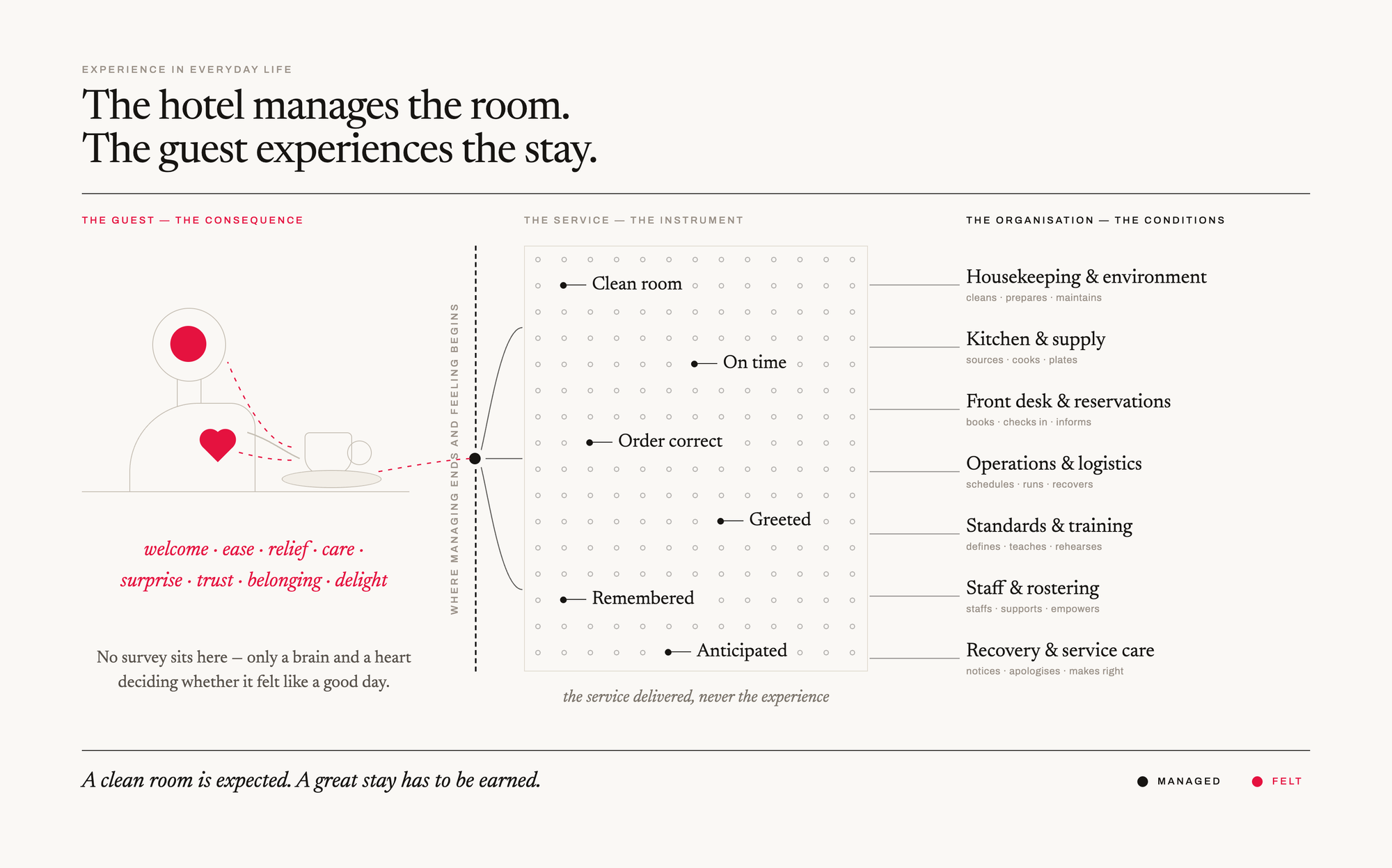
That is why I increasingly find the phrase experience management slightly uncomfortable.
Experiences are felt. They are not managed.
What we can manage are the conditions from which an experience emerges.
There is another distinction here that I think is equally important. Simply meeting an expectation does not automatically make something a great experience.
There is a baseline.
Below that baseline, expectations are broken. At the baseline, expectations are met. Beyond that baseline, something additional becomes possible. Effort disappears. Time is returned. Complexity is removed. A need is anticipated. Confidence increases. Someone feels understood. Something becomes easier or better than they reasonably expected it to be.
That is when an experience begins to become noticeable.
So perhaps experience isn’t something an organisation can simply declare that it delivers.
Experience is an outcome. And an outcome has to be earned.
Why should Digital Experience be any different?
An employee does not come to work to experience technology.
They come to work to do something.
A salesperson wants to sell. A developer wants to build. An analyst wants to analyse. A designer wants to create. A doctor wants to treat a patient. A manager wants to make decisions.
People come to work to accomplish things.
Technology is an instrument they have been given to help them do that work.
The laptop, applications, network, collaboration platforms, enterprise systems and, increasingly, AI are all instruments of work. They exist to enable the employee to perform whatever work the organisation needs them to perform.
So what should we reasonably expect from those instruments?
The laptop should work. The application should open. The network should connect. The meeting should not keep dropping. The employee should have access to the things they need. Applications should perform adequately. And when something does go wrong, support should help resolve it.
These things matter enormously.
But if all of them happen exactly as expected, should we really describe that as a great Digital Employee Experience?
Or has technology simply done the job we provided it to do?
That is a question I have been thinking about for much longer than I realised.
Years ago, while writing about the digital workplace, I used the analogy of a theme park. What visitors see above the surface—the rides, excitement and enjoyment—depends on an enormous amount of invisible operational work underneath. My conclusion then was that experience could not really be offered as an isolated service. It emerged as an outcome of infrastructure and services working together effectively.
I still believe that.
But I think there is another layer to it now.
Reliable technology and efficient support create the foundation. They remove the failures that prevent work. They establish the minimum conditions within which a better experience can emerge.
But they are not necessarily the experience itself.
Imagine instead that the technology environment notices something that is going to slow me down and resolves it before I encounter it. It removes several unnecessary steps from something I perform every day. It helps me discover a capability I did not know existed. It recognises that I am struggling with a new application and guides me through it. It helps me adopt a better way of working rather than simply giving me another tool and a training link.
Perhaps it automates something I have been doing manually for months. Perhaps it understands enough about my situation to give me relevant help instead of generic instructions. Perhaps it saves me twenty minutes on a task. Perhaps it prevents an interruption entirely. Perhaps it allows me to accomplish something better, faster or with less cognitive effort than I could before.
Something fundamentally different has happened.
Technology has not merely worked. It has worked for me.
And now there is something for me, as the employee, to actually experience.
This is why I think we need to be careful about what we mean when we talk about Digital Employee Experience.
There is a meaningful difference between technology that works, technology that helps, and technology that elevates what a person is capable of doing.
Technology that works meets the expected functional baseline. It is available, reliable, performant and supportable.
Technology that helps begins removing effort from work. It guides, simplifies, prevents, assists and makes better ways of working easier to adopt.
Technology that elevates goes further. It anticipates, automates, gives time back and enables a person to accomplish something more effectively than they otherwise could.
But even then, I would hesitate to put experience as the next stage in that sequence.
Because experience is not another operational layer.
It sits above all of them.
It is the human consequence of how those layers came together while someone was trying to work.
That distinction also changes how I think about managing Digital Employee Experience.
IT can manage technology. It can manage performance. It can manage availability. It can manage support. It can manage incidents. It can manage devices and applications. It can manage adoption programmes. It can identify friction and remove it. It can design proactive interventions. It can automate unnecessary work. It can continuously improve all the conditions surrounding an employee’s interaction with technology.
And it should.
But perhaps IT cannot actually manage the employee’s experience.
The employee owns that part.
Two people can interact with exactly the same technology and experience it differently. Their expectations are different. Their familiarity is different. Their work is different. Their confidence is different. Their context is different. What feels effortless to one person can feel frustrating to another.
Experience is ultimately personal.
So perhaps the ambition of Digital Employee Experience should not be to manufacture delight or somehow directly “manage” how employees feel about technology.
Perhaps the ambition should be much more grounded.
Make the technology extraordinarily reliable. Make support extraordinarily effective. Remove unnecessary friction. Help people adopt what has been given to them. Guide them when they need guidance. Anticipate problems where possible. Eliminate work they should never have needed to perform. Give them time back. Help them become more capable through the technology they use.
Do those things exceptionally well, and something important may happen.
The employee may experience work as easier.
They may feel less frustrated. More confident. More capable. Better supported. Perhaps, occasionally, even delighted.
But that judgement belongs to them.
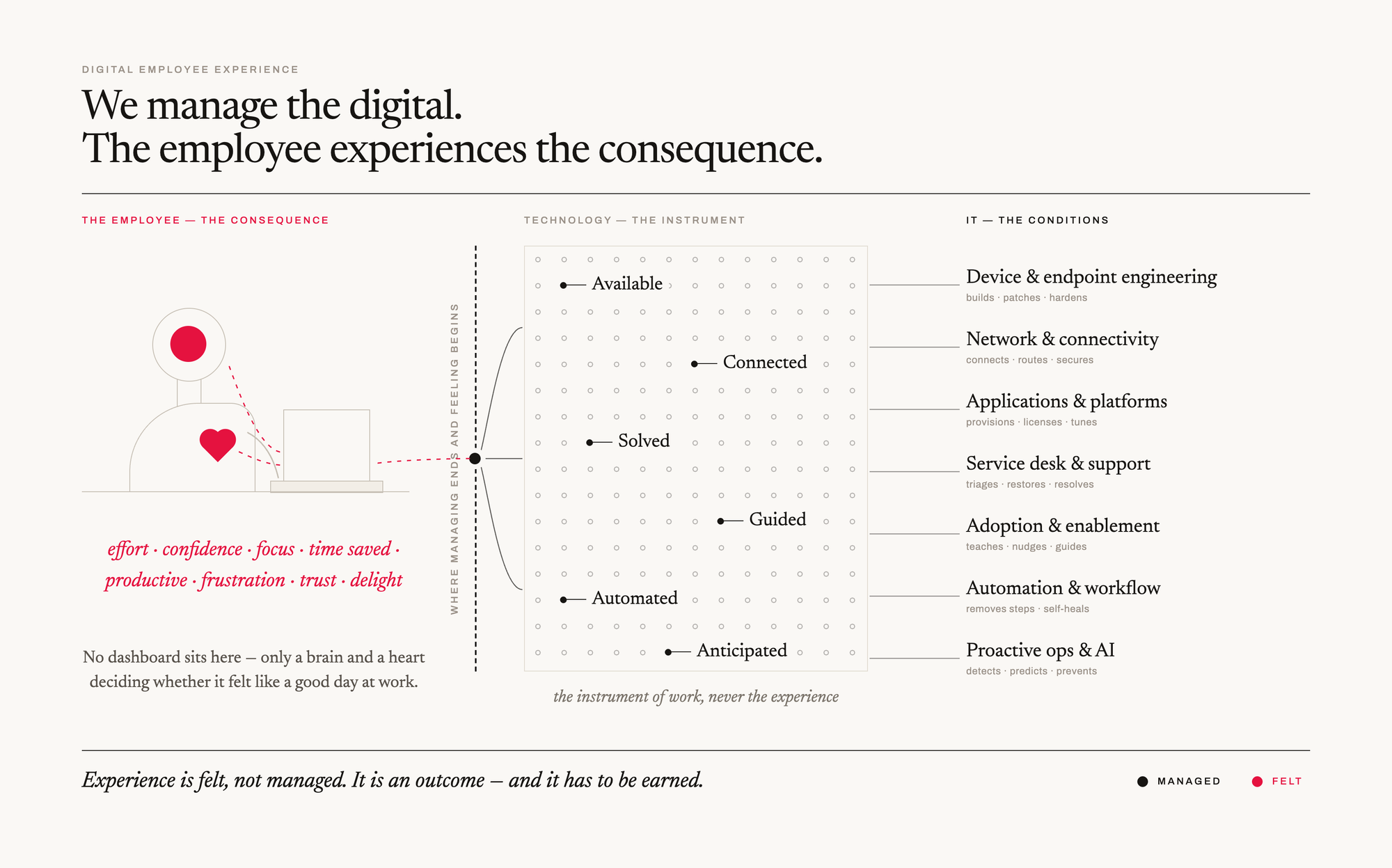
Maybe that is the simplest way I can now describe Digital Employee Experience:
We manage the digital. The employee experiences the consequence.
And when that consequence becomes meaningfully better than merely getting the technology to work, perhaps we have earned the right to call it a great experience.
Because experience is felt, not managed.
It is an outcome.
And it has to be earned.